
Why Doesn’t Dedicating Merit Eliminate Hell or End Wars?
Question: Reciting Amitabha's name generates profound merit. Many practitioners dedicate this merit towards great causes – such as the rebirth to the Pure Land of beings suffering in the three lower realms, or world peace.Yet these realms of suffering remain, and conflicts erupt around the world every day. How, then, does such dedication actually bring any benefit?
Master Jingzong's reply: That’s a fair question. We acknowledge the immense merit of Amitabha-recitation, and we see countless practitioners making vows and dedicating merit all the time. So why does it seem ineffective? If our dedication produces no result, why bother with it at all? And without visible outcomes, how can we claim that Amitabha-recitation yields profound merit?
There are layers to this question. To answer it properly, we need to clarify what "merit" and "dedication" actually mean.
Merit
Merit has both essence and function. The essence is its fundamental substance; the function is its practical effect. The act of reciting Amitabha's name is the essence – and this cannot be transferred to others. Its function, however, – the beneficial effect of such practice — can indeed be shared.
Think of a lamp in your room: the lamp itself is the essence; the light it casts is the function. If you give the lamp away, you no longer have it. But if you open the curtains, the light shines beyond your room and reaches others as well.
When we recite "Namo Amitabha Buddha," the essence remains within our own mind, yet the radiance of its function can extend outward. This is the distinction between the essence and function of merit.
Dedication
Now let’s consider dedication – the act of directing merit toward a specific purpose. This works differently for ordinary beings and sages. An ordinary being directs merit within a relatively narrow scope, while a sage's dedication is vast and all-encompassing. A sage's mind is expansive and non-discriminating, naturally aligned with universal compassion.
An ordinary mind, by contrast, is limited and self-focused. When such a person dedicates merit to someone close – like a parent or child — the beneficial effect actually becomes more concentrated. A limited mind, when sincerely focused on someone dear, channels its energy more effectively.
When that same ordinary mind tries to dedicate merit to all beings in the lower realms or to world peace, it’s like hoping a small lamp in your room will illuminate the entire world. The aspiration is genuine, but the tangible effect is minimal. It’s more realistic to say, "This lamp is enough to light the way for those of us here."
When a sage dedicates merit, however, it’s like the light of the sun – naturally illuminating everything in all directions. This is the realm of Buddhas and Bodhisattvas. The merit of Amitabha-recitation is immense; it "surpasses the light of the sun and moon." Yet for ordinary beings like us, with our narrow minds, although we may fully receive the essence of such merit, we can transfer only a tiny fraction of its function to benefit others.
Therefore, when we ordinary beings dedicate the merit of Amitabha-recitation toward beings in the three wretched realms, toward world peace, or toward all beings everywhere, the actual benefit reaching others is minimal. This answers your question about why realms of suffering persist and why conflicts continue—given our limited capacity, such an outcome is entirely natural.
Does this mean we should stop dedicating merit? Not at all. The Commentary on the Treatise on Rebirth teaches that “one should constantly resolve to practice merit-dedication above all else so as to achieve great compassion."
Although our power to help others directly is limited, the very act of aspiring toward such generosity profoundly transforms us. It expands our own capacity for compassion.
Dedication by Sages
Next, let’s consider merit-dedication by enlightened sages. Buddhas and Bodhisattvas vow to benefit all sentient beings and dedicate all their merits to them.
One might then ask: "If the Buddhas and Bodhisattvas possess such great merit and such powerful vows - generating boundless bodhicitta (wishing others to attain enlightenment) that pervades the entire universe – and if they are constantly dedicating their merits, then why do the three lower realms still exist? Why is there still no world peace? I can understand my own limitations as an ordinary being. But what about the sages– they’re dedicating merit too, aren’t they? But where’s the effect of their dedication?
If their dedications have no effect, does that mean the Buddha-Dharma is not real? And if the Buddha-Dharma is real, why don’t we see its benefits?"
Raising probing questions like these actually helps us get closer to the heart of the issue.
To get to the heart of the issue, we must look from both sides: the perspective of the dedicators – Buddhas and Bodhisattvas – and the perspective of the recipients – ordinary beings trapped in samsara.
From the perspective of Buddhas and Bodhisattvas
Buddhas and Bodhisattvas have attained perfect enlightenment. And they achieved that precisely because they constantly practice merit-dedication above all else, thereby perfecting great compassion. It is by fulfilling both wisdom and compassion that they attained Buddhahood. To them, the three lower realms do not exist.
How can this be? Think of light itself: being the very substance of illumination, it never encounters darkness. Wherever light reaches, there is only brightness.
The Diamond Sutra says: "I must lead all sentient beings to the shore of awakening but, after these beings have become liberated, in truth I know that not even a single being has been liberated." This sounds paradoxical, but it points to something profound. The Buddha doesn’t conceive himself as rescuing helpless creatures, for he sees clearly that all beings already possess the same awakened nature he has realized – it is simply obscured by ignorance. He has also seen through the illusion of a separate, independently existing self – not just in persons, but in all phenomena.
From this vantage point, there is no “I” doing the saving and no tally of “how many I have saved.” Reality, at its deepest level, is already nirvana – a state of profound peace, freedom, the cessation of craving and the end of cyclical existence. The suffering that beings experience is like a nightmare: vivid and tormenting while it lasts, yet without ultimate substance. If suffering is like a bad dream, what sense does it make to ask whether hells truly exist?
In the eyes of Buddhas and Bodhisattvas, everything is already a pure land. So why do they still work to save sentient beings? This seems contradictory—why act to fix something you know isn't ultimately broken?
This is what we call compassionate action amid illusion: helping those who are trapped in a dream they mistake for reality.
From the Buddha's perspective, there is complete freedom and liberation. But ordinary beings don't see this. They remain caught in an exhausting cycle—chasing, striving, suffering, dying, and being reborn again and again. They wear themselves out over things that have no ultimate substance, creating karma that binds them ever more tightly.
Out of compassion, Buddhas and Bodhisattvas appear in this world to guide them toward awakening. But these appearances are themselves part of the dream. The Buddhas enter the illusion to help those inside it, while never forgetting that the illusion is just that—an illusion.
The Buddha doesn't act because he believes beings are truly trapped. He acts because beings believe they are trapped, and that mistaken belief causes them real anguish. So the Buddha enters their dream to show them the way out—even though he knows the trap was never real to begin with. This is why there is no contradiction. His response is perfect and compassionate, yet free of any sense of a doer or a deed.
From the Perspective of Sentient Beings
From our standpoint as ordinary beings, does the dedication of Buddhas and Bodhisattvas have any effect on us? It certainly does.
All beings inherently possess Buddha-nature – a seed of awakening already present within us. The problem is that we’ve lost sight of it. Through ignorance and misperception, we turn away from this innate nature and become caught in the endless cycle of birth and death.
Buddhas and Bodhisattvas dedicate to us the merit they have accumulated through attaining perfect enlightenment. This works on us in ways we cannot immediately see or feel – a subtle, gradual influence operating beneath the surface of our awareness.
Awakening becomes possible through the combination of two factors: this external nurturing from Buddhas and Bodhisattvas, and the internal capacity we already possess – our Buddha-nature. This innate nature is called the "primary cause for Buddhahood." Without it, no amount of external help such as dedication of merit could ever lead to enlightenment.
Think of it this way: wood contains the latent capacity to burn. Touch a flame to it, and it catches fire. But you could hold a flame to a pile of soil forever and nothing would happen – soil simply lacks that capacity.
Buddhas and Bodhisattvas have been teaching us and forming connections with us across unimaginable stretches of time. Through their unceasing dedication, conditions have now ripened for us to hear the name of Amitabha Buddha, learn of his Pure Land, feel drawn to recite his name, and aspire for rebirth there.
The timing for each being's awakening varies: some are ready sooner, others later. The karmic obstacles we carry differ in weight, and our connection with Buddhas and Bodhisattvas differ in strength. These factors make the process deeply intricate. Yet, Buddhas and Bodhisattvas never hold the notion that “I am saving these beings.” Their compassion flows naturally, without any sense of ownership or accomplishment.
Conclusion
From the Buddha's standpoint, all is eternally a pure land; all sentient beings are inherently Buddhas, for the Buddha has already achieved perfect enlightenment. From the standpoint of sentient beings, however, the cycle of rebirth continues, along with boundless suffering.
As the verse says: "In the dream, the six realms appear vividly real. Upon awakening, the entire universe is revealed as an illusion." Within our dreamlike existence—through the long night of ignorance—the six realms of rebirth seem utterly real. Yet once Buddhahood is attained, we realize none of it ever truly existed.
Here lies the greatness of the Buddha's compassion: after awakening and seeing that beings' suffering has no ultimate substance, he does not simply stand back and say, "Your pain is unreal—just a play of illusions." Instead, with profound wisdom, power, and compassion, he enters the very dream-world of sentient beings to guide them toward liberation.
(Translated by the Pure Land School Translation Team;
edited by Householder Fojin)
Master Huijing
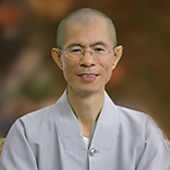
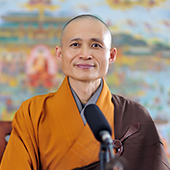
Master Jingzong
Guiding Principles
Faith in, and acceptance of, Amitabha’s deliverance
Single-minded recitation of Amitabha’s name
Aspiration to rebirth in Amitabha’s Pure Land
Comprehensive deliverance of all sentient beings